Best Franchise Opportunities in Raleigh, North Carolina

Get Your Free, Personalized Franchise Match Report

Answer a few quick questions and get matched with franchise types that fit your budget, time, and ownership style.

Step 11 / 6

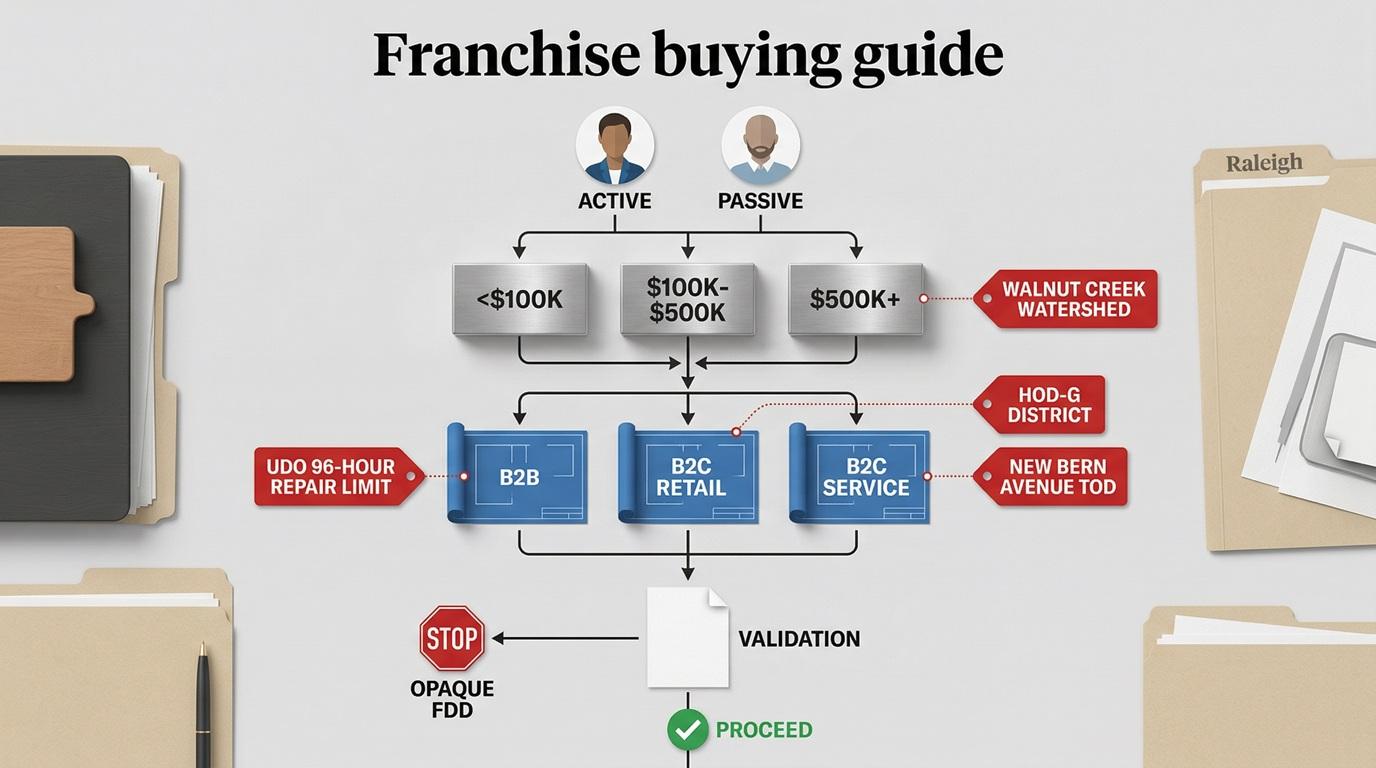
What kind of ownership style fits you best?

What’s your investment comfort range?

What kind of business fits you best?

How soon do you want to start?

What’s your weekly time capacity?

Where should we send your results?

Free to buyers. We use this to send your results and follow up with relevant franchise options. No spam.

Book a free call to discuss 100s of opportunities we didn’t have space to display on this page.

Disclaimer & Affiliate Disclosure: This content is for informational purposes only and does not constitute financial, real estate, or legal advice. Franchise investments carry significant risk. We may receive referral fees from featured brands. Always independently verify local market data, review the Franchise Disclosure Document (FDD), and consult a licensed CPA or attorney before investing capital..
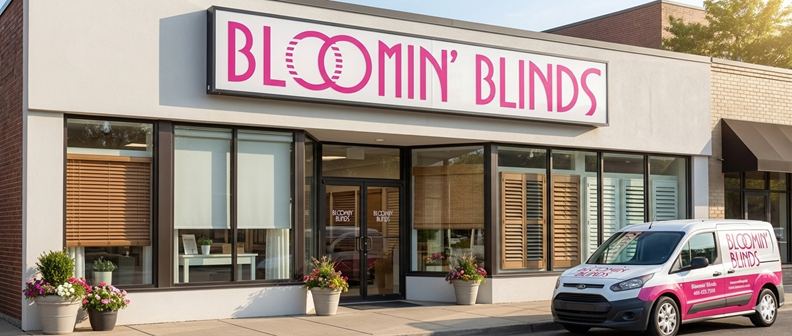
Bloomin' Blinds

The North Hills district in Raleigh functions as a dense, high-income commercial node where localized fleet logistics dictate operational capacity. Routing a Bloomin’ Blinds mobile fleet through this territory requires navigating extreme congestion on Six Forks Road, where narrow lane widths of less than 9 feet and ongoing protected intersection construction severely dilute billable hours.

Within the window treatment sector, Carolina Blinds and Shades maintains a highly successful, personalized owner-operator presence. Their localized bandwidth creates a distinct, unfulfilled market gap for a tech-enabled fleet capable of deploying standardized supply chain logistics and rapid appointment availability.

Demand is driven heavily by the 2 million square feet of Class A space within the North Hills Office Portfolio, housing time-poor professionals at Gilead Sciences and Bank of America who prioritize in-home service convenience.

Compliance with the Raleigh Unified Development Ordinance (UDO) presents an immediate OpEx hurdle; parking decks here feature restricted 6’8″ vertical clearances, forcing operators to secure off-site commercial storage for high-roof Sprinter vans.

Operationally, the model relies on executing precise ultrasonic cleaning tank fluid logistics while leveraging a “Repair-First” protocol. Sources: visitraleigh.com, library.municode.com

Franchise overview
Marketing fund (in %)2%
Minimum cash required$25,000
Franchise fee$49,500
Who Has an AdvantageA charismatic owner-operator with strong project management skills, comfortable with fleet management.
Request more information now
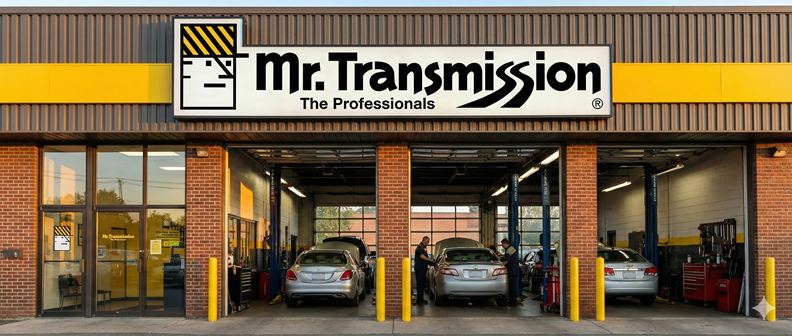
Mr. Transmission

The Cameron Village area merges legacy commercial uses with tightening zoning controls. Facility operators must navigate the Raleigh Unified Development Ordinance, which strictly prohibits vehicle repairs exceeding 96 hours in transition zones, effectively capping revenue on complex rebuilds.

Establishing this use requires an $800 Special Use Permit filing fee and a Board of Adjustment hearing. The local demographic is bolstered by North Carolina State University, introducing over 36,000 students and 9,019 employees driving older, high-mileage vehicles.

Village Motor Works at 234 S Boylan Ave anchors the market with highly regarded specialization in European and Japanese imports. Their technical focus leaves a distinct service gap for standardized, tech-enabled communication and digital pricing transparency.

The neighborhood also features a Transit-Oriented Development layout with pedestrian-centric street designs that complicate heavy truck navigation and parts delivery. Mr. Transmission addresses these operational hurdles by using a centralized tech hotline that aggregates failure data into diagnostic flowcharts.

The shop infrastructure administers national warranty claims efficiently while maintaining strict adherence to EPA standards for used oil storage. Sources: raleighnc.gov, ncsu.edu

Franchise overview
Marketing fund (in %)N/A
Minimum cash required$57,500
Franchise fee$45,000
Who Has an AdvantageA B2B Sales Hunter who's not afraid of fleet account management. An active owner-operator, focused on local business relationships.
Who Is a Bad FitAbsentee investors that aren't used to high-ticket sales, both B2B and B2C.
Request more information now
About the page’s author, Thomas Jepsen
Franchise consultant & growth strategist
As seen in: Yahoo Finance

Master’s in Accounting, Strategy & Control. FBA-certified in franchises and FDD analysis. Raised institutional funding and completed a venture exit. Has advised aspiring franchisees on 20+ different business categories. Thomas helps aspiring franchisees evaluate brands objectively.

Thomas Jepsen
Magnolia Soap

Retail operations in Mordecai require navigating the Wake Forest Road “Road Diet,” which reduced the corridor to three lanes and actively limits street parking availability for quick retail stops.

Despite these vehicular hurdles, the daytime population is anchored by the NC State Government Complex’s 4,000 downtown employees and the demographic surrounding William Peace University at 15 E Peace St.

The local sector is supported by Anders Natural Soap Co. at 1943 Evans Rd, a highly successful maker with strong weekend farmers market penetration. Their specific destination format leaves an uncaptured consumer desire for accessible, seven-day-a-week tactile retail.

Capturing this walk-in demand, Magnolia Soap is designed to increase revenue per square foot during off-peak hours by deploying a “Party-in-a-Box” protocol for in-store events. Managing these bath bomb parties requires rigorous cleanup of slip hazards, alongside high-turnover HVAC ventilation to mitigate staff olfactory fatigue.

Initial site selection must clear the Raleigh Historic Development Commission’s Neighborhood Conservation Overlay District, which strictly governs setbacks, with zoning violations triggering a $100 civil penalty.

Franchise overview
Marketing fund (in %)1%
Minimum cash required$52,500
Franchise fee$60,000
Request more information now
Rush Bowls

The historic streets of the Oakwood trade area impose strict Residential Permit Parking constraints that restrict non-resident access, limiting consumer dwell time and necessitating a high-turnover retail model.

The local demand generator is the North Carolina State Government Complex, injecting over 24,000 state employees into the daytime lunch market. The established health-food sector features deeply aligned operators like Raleigh Raw on W Hargett St, highly successful at delivering pure ingredients.

This creates a specific consumer demand for high-speed, functional fuel options to accommodate time-crunched administrative workers requiring rapid throughput. Inside the facility, Rush Bowls staff must balance the output of the blender and topping stations to prevent melting product during peak rushes, while strictly highlighting dietary modifications on tickets to prevent costly remakes.

When projecting capital expenditures, operators must factor in the Raleigh Historic Development Commission’s signage codes, which cap illumination at 10 footcandles and require custom wood or metal fabrication. To navigate this tight environment, the franchise utilizes a proprietary Blender Wall layout engineered to support maximum throughput within a compact footprint.

Franchise overview
Marketing fund (in %)2%
Minimum cash required$57,500
Franchise fee$39,000
Who Has an AdvantageThe health-conscious marketer who is familiar with guerrilla marketing.
Who Is a Bad FitThe supply chain novice.
Request more information now
Franchise owner success story
Client Success Story
“Thomas helped me find the franchise that actually fit my goals.”
— Jeff, Franchise Owner
Read case study
Paul Davis

Service demand in Boylan Heights is consistently driven by the dense rental housing stock surrounding NC State University, providing a robust pipeline of B2B property managers. The dominant incumbent, PHC Restoration at 301 West Cabarrus Street, commands the territory through five decades of legacy relationships.

Their traditional infrastructure creates an unserved gap for scalable, rapid-response surge capacity during peak storm events. Navigating this neighborhood presents immediate logistical hurdles, specifically due to a curving street grid lined with old-growth trees.

Deploying a 26-foot restoration box truck through these narrow lanes frequently forces crews to temporarily block traffic during equipment unloads. Facility operations are rigorously governed by the General Historic Overlay District (HOD-G), which restricts new curb cuts and prevents heavy commercial fleet storage.

This necessitates a split-operations approach, requiring a localized office while leasing a separate industrial yard for fleet staging. Paul Davis facilitates local restoration needs through an integrated mitigation model, systematically managing 24/7 on-call rosters and strict subcontractor Gantt charts.

Franchise overview
Marketing fund (in %)N/A
Minimum cash required$87,500
Franchise fee$136,500
Request more information now

Factors to consider

The physical movement of labor and goods is currently affected by the I-440 Widening Project. This heavy civil project expands a 1.3-mile segment from two to four lanes, introducing concrete placement and temporary lane closures that force delivery drivers to adjust turnaround times along the beltline. For fixed-location build-outs, the city absorbs millions in commercial exactions, including projected Park Facility Fees and general Facility Fees, into its operating budget.

However, the municipal planning guidelines do not publish a rigid per-square-foot formula for commercial prototypes. Operators will need to submit specific site plans to the development services department during due diligence to verify the exact scheduled capital required for these impact exactions prior to breaking ground.

Local operator insights

In ongoing discussions, QSR local operators expressed significant concern that the New Bern Avenue Transit-Oriented Development (TOD) overlay is actively rejecting their low-density suburban formats and drive-thru lanes. To maintain their development pipelines, these operators are pivoting toward peripheral greenfield nodes unlocked by the newly commenced Complete 540 Extension. Simultaneously, sit-down dining concepts reported severe administrative friction at the Raleigh Permit Center.

Because critical fire plan reviewer positions remain vacant, operators are being forced to front-load their holding costs to absorb indefinite life-safety inspection delays before standard build-outs can legally commence.

Our Evaluation Methodology

  • 1
    Franchisor Vetting & Financial Due Diligence

    FDD audit, Raleigh's dynamic pulse guided us. Stability linked to local economy. Item 19 & litigation history vetted, ensuring financial resilience & guided choice.

  • 2
    Local Market Feasibility & Demographic Alignment

    We selected franchises based on Raleigh's 50th percentile age, household unit earnings, and population density versus their aim demographic to ensure local market compatibility.

Expert Reviewer(s)

Poll Morefield
Poll Morefield
Franchise Lawyer

15+ years of experience with franchise law.

Fred M. Wolfe
Fred M. Wolfe
CPA

10+ years experience as a CPA.

Earnings disclaimer

If any earnings claims are made for a prospective franchisor, those are verified against the Item 19 FDD version specified.

Disclaimer: The information above is not an offer to sell or a solicitation of an offer to buy a franchise. Offers are made only through the delivery of a FDD. Consult a lawyer when reviewing an FDD. Investment ranges/requirements sourced from FDDs.

Book Free Franchise Consultation