

Cookie Advantage’s 2026 FDD reported an impressive 20% jump in average franchisee sales. However, there was an absolute lack of new store openings raises a more complicated question about the system’s growth story. While the brand’s unit economics are moving in the right direction on paper, the overall franchised network actually shrank. For buyers and operators, this presents a classic franchise tension:
Is the brand setting its franchisees up for soaring success, or is it struggling to sell its concept in a crowded market dominated by giants like Crumbl?
I always get iffy when I see a franchisor projecting additional franchise sales, not delivering, and only expanding their corporate system.
— Franchise Thomas (@franchisethoma1) April 27, 2026
Does Cookie Advantage's latest FDD reveal the system's in trouble?
Cookie Advantage operates in the highly competitive dessert and gifting space, an industry where unit economics and rapid scaling often dictate long-term survival, at least for the franchisor. The data analyzed here stems from the brand’s consecutive 2025 and 2026 FDDs, which primarily cover financial data from calendar years 2024 and 2025, respectively.
Tracking a brand’s FDD year-over-year is the most reliable way to cut through franchise’s marketing speak, aside from doing validiton calls. While an emerging system might show double-digit sales growth, true system health requires analyzing fees, initial investments, and actual unit counts. To provide industry context, I am also benchmarking Cookie Advantage’s latest figures against the 2025 FDD from category leader Crumbl, which reflects 2024 data. Crumbl offers a useful benchmark, though not a direct year-over-year comparison for Cookie Advantage.
A side-by-side look at Cookie Advantage’s 2025 and 2026 FDDs reveals a mix of stagnant entry costs and climbing top-line revenues.
- Item 5 (Initial Fees): The upfront cost to buy the franchise remains totally unchanged at $34,900. Required initial packaging purchases from the affiliate also remained flat at $2,500. The brand collected no initial fees in the prior fiscal year, signaling a halt in new franchise sales.
- Item 7 (Estimated Initial Investment): The total estimated initial investment range is completely identical to the previous year: $92,550 to $171,250. The franchisor did not change a single line item.
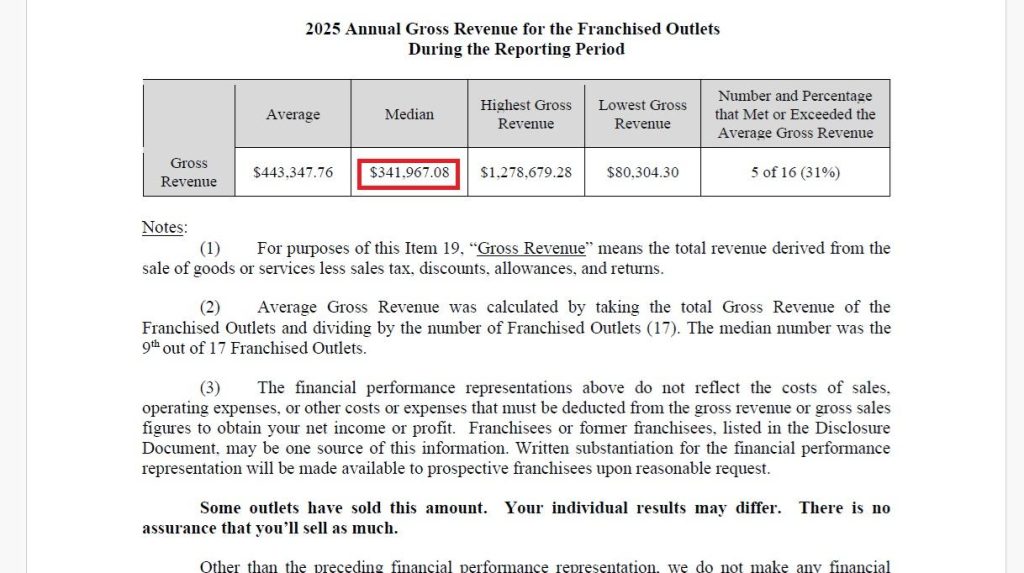
- Item 19 (Financial Performance Representations): The company’s Item 19 reveals massive top-line growth. Average Gross Revenue surged 20.0%, from $369,522.44 to $443,347.76. Median Gross Revenue jumped an even higher 31.1%, climbing from $260,925.10 to $341,967.08. These numbers should be seen in context.
- Item 20 (Outlets and Franchisee Information): According to Item 20, franchised outlets dropped from 17 to 16 by the end of 2025. Zero new franchised units opened, despite the brand projecting 5 openings in the previous FDD. Was this intentional? Meanwhile, company-owned outlets grew 33.3%, from 6 to 8. The franchisor also reacquired one franchised unit in 2025. The brand projects 5 new franchised units for the upcoming year.
To be noted: Cookie Advantage’s FDD Item 3 revealed no litigation requiring disclosure.
Revenue Boom vs. Franchise Contraction
The most glaring contradiction in the 2026 FDD is the massive surge in average unit volume (AUV) against a shrinking franchisee base. The middle-of-the-pack operator saw a 31% leap in gross revenue, yet the brand lost one franchised location and opened absolutely zero new ones. At the same time, the franchisor expanded its own corporate footprint by two locations.
In my experience reviewing FDDs, when I see a 31% median revenue jump alongside unit reacquisitions, the first thing I look for is survivorship bias. Cookie Advantage bought back one struggling unit in 2025. When a franchisor scrubs a low-performing unit from the franchisee data pool to absorb it into their corporate portfolio, the franchisee averages mathematically shoot upward, even if same-store sales remained entirely flat. The Item 19 headline looks strong, but a zero on the “franchised units opened” could tell a story that marketing glosses over.
Furthermore, I am highly skeptical of flat Item 7 startup costs. In an era of intense inflation, Cookie Advantage didn’t change a single digit in their initial investment estimates.
The Crumbl Contrast: Comparing this to Crumbl’s 2025 FDD highlights the vast gulf between emerging brands and category dominators. Crumbl officially surpassed the 1,000-unit mark, ending 2024 with 1,058 franchised locations and a net growth of 88 units.
Crumbl’s Item 19 paints a picture of immense, albeit highly variable, scale. The average Crumbl store generated $1,354,688 in gross sales. However, this scale requires deep pockets; Crumbl’s estimated initial investment spans $816,066 to $1,442,533. They also carry a much heavier fee structure: an 8% royalty fee and a 2% marketing fund fee.
While Cookie Advantage is much cheaper to open, Cookie Advantage is generating tiny number’s compared to Crumbl’s average volume. A realistic take on why Cookie Advantage’s projected openings miss the mark is that buyers may be opting to spend more money to join a system like Crumbl that has a proven track record.
Cookie Advantage Sales Jumped. Its Franchise Count Did Not.
Cookie Advantage’s latest FDD shows a sharp rise in reported franchisee gross revenue, even as franchised outlets fell and affiliate-owned outlets increased.
In my opinion, Cookie Advantage presents a mixed picture. The revenue growth is highly marketable, but the brand is failing to translate that momentum into new franchise sales. If the franchised unit count continues to shrink while the company-owned footprint expands, it may suggest that the franchisor prefers to run its most profitable units itself rather than collect a 6% royalty from operators. Or, maybe they are struggling to sell more units. Time will tell.